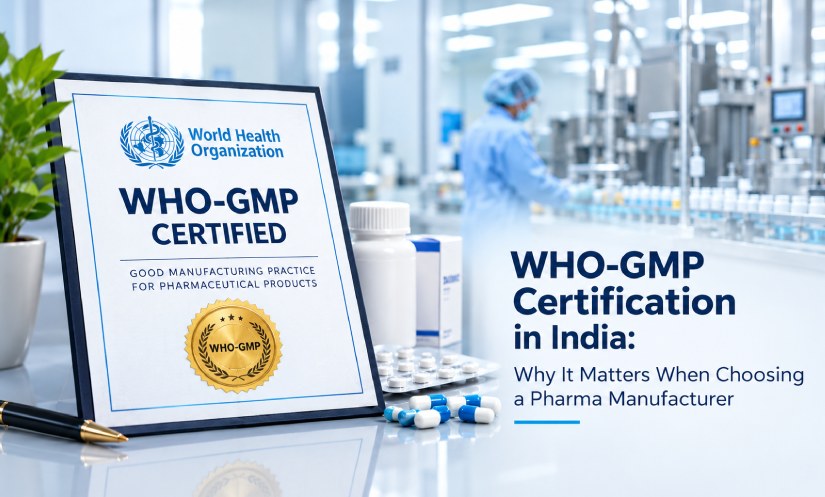
If you’re evaluating PCD pharma companies for a franchise partnership, you’ve probably come across the term WHO-GMP more than once. It shows up on nearly every pharma company’s website, usually next to a badge or a line in the About Us section. But most first-time franchise partners never really get told what it means, or why it should influence their decision at all.
This matters more than it might seem. The manufacturer behind your franchise is the one thing you can’t see or control day to day. You’re trusting them with product quality, consistency, and compliance, and WHO-GMP is one of the clearest signals of whether that trust is well placed. If you’re still comparing options, it’s worth reading this alongside our guide on how to start a PCD pharma franchise in India, since manufacturing standards should factor into that decision early, not after you’ve signed anything.
What Does WHO-GMP Actually Mean?
WHO-GMP refers to Good Manufacturing Practice standards developed by the World Health Organization for pharmaceutical manufacturing. In India, manufacturing facilities may be inspected by the competent drug regulatory authorities for compliance with applicable WHO-GMP requirements, including under the WHO-GMP/CoPP certification process.
These standards are designed to ensure that pharmaceutical products are consistently manufactured and controlled according to appropriate quality standards, while reducing risks such as contamination, mix-ups, incorrect labelling and manufacturing inconsistencies.
In India, WHO-GMP certification follows an inspection of the manufacturing facility and its quality systems, including premises, equipment, documentation, production controls, material handling, quality control processes and the qualifications and training of relevant personnel.
In short, WHO-GMP is not merely a marketing label. It reflects a regulatory assessment of the systems and processes used to manufacture and control pharmaceutical products.
What Gets Checked Before a Facility Is Certified
A WHO-GMP inspection is fairly detailed. It typically covers:
- Facility design and hygiene – suitable premises, sanitation, environmental and ventilation controls, and measures to minimise contamination, cross-contamination and product mix-ups.
- Raw and packaging material– approved suppliers, appropriate specifications, identification, testing or verification procedures, storage controls and documented release before materials are used in production.
- Equipment and machinery standards – calibrated, well-maintained equipment appropriate for the products being manufactured
- Quality control and batch release – defined sampling, testing, specifications and release procedures to ensure materials and finished products meet approved quality requirements before use or supply.
- Documentation and traceability – batch records that let a company trace any product back to its exact production run, in case of a quality concern
- Staff training and hygiene protocols – qualified personnel trained in handling pharmaceutical products correctly
A facility has to demonstrate all of this consistently, not just on the day of inspection, to keep its certification.
Why This Should Matter to You as a Franchise Partner
It’s easy to treat WHO-GMP as a checkbox on a company’s credentials page. But for someone about to invest in a PCD pharma franchise, it has a direct, practical impact on the business you’re building.
- Product consistency protects your reputation: Doctors and chemists in your territory will judge your business by how reliable the products are, batch after batch. WHO-GMP systems are designed to reduce the risk of contamination, mix-ups, manufacturing errors and inconsistent product quality, helping support greater batch-to-batch consistency.
- It can reduce quality and reputational risk: As a franchise partner, you’re the local face of the business for many retailers and doctors. If a manufacturing quality issue surfaces, your reputation in the territory can be affected even though you had no direct control over production. Working with manufacturing partners that follow recognised GMP systems helps reduce exposure to avoidable manufacturing-quality issues.
- It signals investment in quality systems: Maintaining WHO-GMP compliance requires ongoing attention to manufacturing processes, premises, equipment, documentation, validation, personnel training and quality control systems. For a franchise partner, this provides a more meaningful indicator of manufacturing discipline than a marketing claim alone.
- It can support export and institutional opportunities: If you plan to expand into exports, institutional supply or certain government procurement opportunities, internationally recognised GMP compliance can become particularly important. Many markets and procurement processes require manufacturers to provide GMP, CoPP or equivalent regulatory documentation, although the exact requirement varies by country and tender.
Manufacturing quality is particularly important when building a prescription-led portfolio across therapeutic categories such as our cardiac range, diabetic range and derma range, where consistent product quality and dependable supply form an important part of building long-term confidence in the market.
How to Verify WHO-GMP Certification Before You Commit
Don’t take a company’s word for it. Before signing any franchise agreement, ask for and verify:
- The actual certificate, not just a logo on the website. Certificates mention the specific manufacturing unit and validity period.
- The name of the issuing authority and whether the certification is current, including its applicable validity or revalidation status.
- The scope of certification – check the manufacturing site, dosage forms/production areas covered and, where relevant, the products included in the CoPP documentation.
- Manufacturing location, so you can confirm it matches what’s stated in the certificate.
Where applicable, you can also cross-check the manufacturing unit against information published by CDSCO or the relevant drug licensing authority.
A company that’s confident in its certification will have no hesitation sharing these details. Hesitation or vague answers are a reason to look elsewhere. This is also a good moment to check the fine print on monopoly rights and agreement terms and to get clarity on the investment and cost breakdown, since certification, territory rights, and cost all need to check out together before you commit.
The Bigger Picture
WHO-GMP certification isn’t the only thing to evaluate when choosing a pharma manufacturer, but it’s one of the few objective markers you have. Things like brand promises, marketing support, or investment terms can all sound appealing on a sales call. Unlike general marketing claims, manufacturing certifications are supported by regulatory documentation and can be independently verified, making them a useful starting point when evaluating a potential pharma partner.
At Globus Labs, our products are manufactured through WHO-GMP certified manufacturing partners, with quality and regulatory compliance forming an important part of how we select and work with our manufacturing network.
Prospective franchise partners are welcome to ask our team for relevant manufacturing and certification details before onboarding. If you’re evaluating a PCD pharma franchise opportunity and want to explore our manufacturing standards, therapeutic portfolio, monopoly rights and franchise terms, get in touch with the Globus Labs team.