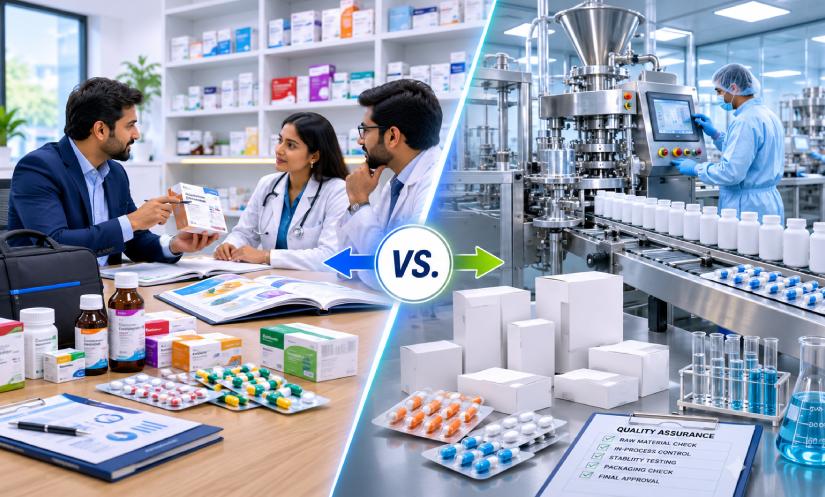
If you’re planning to enter the pharmaceutical business in India, you’ve likely come across two terms that get used, and confused, all the time: PCD pharma franchise and third-party manufacturing. Both involve partnering with an established pharma company. Both let you sell medicines under a brand name. And both are far less capital-intensive than setting up your own manufacturing unit. But that’s roughly where the similarities end.
Picking the wrong model can mean overpaying for something you didn’t need, or worse, missing out on the exclusivity and support that would have made your business easier to run. This guide breaks down exactly how these two models differ, so you can choose the one that actually fits your goals.
What Is a PCD Pharma Franchise?
PCD stands for Propaganda Cum Distribution. In this model, a pharma company grants you the rights to market and distribute its products in a specific area, usually a district, state, or region, under its brand name. You operate as a franchise partner rather than a manufacturer.
The pharma company typically provides product samples, visual aids, promotional material, MR bags, and sometimes monopoly rights for your territory. Your job is to build relationships with doctors, chemists, and stockists, and grow sales within your assigned area. You’re not involved in production at all; that stays entirely with the company.
What Is Third-Party Manufacturing?
Third-party manufacturing, also called contract manufacturing or loan licensing, works differently. Here, you bring your own brand name and formulation requirements to a manufacturer, and they produce the medicines for you under your label. You own the brand. You decide what gets made, in what packaging, and under what name.
This model is common among businesses that want to build their own pharma brand from the ground up but don’t want to invest in a manufacturing facility. You handle marketing, distribution, and sales entirely on your own, while the manufacturer focuses purely on production.
Key Differences Between the Two Models
1. Brand Ownership
This is the single biggest difference. In a PCD franchise, you sell products under the parent company’s established brand name. You benefit from their existing market reputation, but you don’t own the brand yourself. In third-party manufacturing, the brand is entirely yours. You build it, you own it, and its value is yours to keep, but you also carry the entire burden of establishing that reputation from scratch.
2. Investment Required
A PCD pharma franchise generally requires a lower upfront investment. You’re paying for stock, some promotional material, and possibly a security deposit, but the company already has manufacturing, quality control, and often regulatory approvals in place. Third-party manufacturing usually demands a higher initial investment since you’re responsible for formulation development, packaging design, regulatory filings, and often a minimum order quantity per batch.
3. Marketing and Distribution Support
PCD franchise partners typically receive ready-made marketing support: product literature, visual aids, and sometimes even training. The company has already done the work of building product credibility. In third-party manufacturing, marketing is entirely on you. There’s no inherited brand trust to lean on, which means a longer runway before you start seeing consistent sales.
4. Territory Rights and Monopoly
Many PCD pharma franchises offer monopoly rights for a defined territory, meaning no other franchise partner from the same company can operate in your area. This reduces internal competition and gives you room to grow locally. Third-party manufacturing doesn’t work on territory at all since you’re building an independent brand that can be sold anywhere, but that also means there’s no protective boundary keeping competitors out of your patch.
5. Control Over Product Range
With a PCD franchise, you choose from the company’s existing product portfolio. You can’t request custom formulations or packaging. Third-party manufacturing gives you full control: you decide the formulation, dosage form, packaging design, and even the composition, within regulatory limits, of course.
6. Risk and Long-Term Value
A PCD franchise is lower risk and faster to start, but the long-term brand equity you build ultimately benefits the parent company, not you. Third-party manufacturing carries more risk upfront and demands more patience, but every bit of goodwill you build stays with your own brand, something you can eventually scale, expand, or even sell as a business asset.
Which Model Should You Choose?
If you’re new to the pharma business and want to start with lower investment, faster setup, and the backing of an established brand, a PCD pharma franchise is usually the smarter starting point. It lets you learn the market, build relationships with doctors and chemists, and generate steady income without the complexity of running your own brand.
If you already understand the pharma distribution landscape, have a clear brand vision, and are prepared to invest more time and capital into building something that’s entirely your own, third-party manufacturing gives you that ownership and long-term upside.
Many successful pharma entrepreneurs actually start with a PCD franchise to understand the market, then transition into third-party manufacturing once they have the experience, capital, and confidence to build their own brand.
Final Thoughts
There’s no universally “better” model between the two. It comes down to how much control you want, how much risk you’re willing to take, and how quickly you want to get started. A PCD pharma franchise offers a faster, lower-risk entry with an established brand behind you. Third-party manufacturing offers full ownership and long-term brand value, at the cost of a bigger upfront commitment.
If you’re leaning toward the franchise route, choosing the right partner company matters just as much as choosing the model itself. Look for a company with a strong product portfolio, WHO-GMP certified manufacturing, transparent monopoly terms, and genuine on-ground support, so your franchise has the best possible chance of success.